
Prisons (Part 2: Dignity)
TLDR: Recidivism and cost both decrease while dignity and well being increase when normalization is embraced. Self-staffing is good, as long as strong norms are enforced and escape is actually prevented. Utopia emphasizes consent by allowing both prisons and (basic-income-funded) prisoners to shop around.
Prerequisites: Part 1, Adjudication, section on Utopia builds on many important ideas from Basic Income, Freethought, and more.
Prisons are a nightmare.
Outside of some exceptions, like Bastøy, prisoners around the world are subject to daily indignities,1 including:
Brutally hard and uncomfortable environments
Forced contact with awful people
Lack of personal space
Lack of privacy
Lack of ability to really work or study
Forced labor for little or no money (a.k.a. slavery)
Note that all of those hyperlinks go to cases in American and British prisons. Institutions in less-wealthy places are often much worse. It should be no wonder that the suicide rate in prisons and jails is many3 times higher than it is in the broader world.
In full view of all this, it’s no wonder that reformers nearly everywhere seek to emulate the more humane Nordic model and invest in restoring dignity.
But from my perspective, one of the worst parts of the situation is that the conflict between high spending and inhuman cruelty is a false dichotomy. There are ways to simultaneously restore dignity, reduce recidivism, and keep costs low. This essay is about how.
Universal Rights
Before getting to prison reform per se, I want to take a detour through the notion of rights. A right is a normative principle that specifies what duties4 (actions that are either forbidden or mandatory) some party has towards each person in some class (the holders of the right). For instance, a “right to free speech” might stipulate that the state has a duty not to prevent a citizen from expressing their ideas to other people. A “right to clean water” might stipulate that restaurant owners have the duty to serve tap water to customers without charging money.
Regardless of whether rights are natural5 or merely a legal construct, they are an undeniably foundational part of the social order. Laws that are based on solid principles will be clear and compelling, where laws that don’t have a principled backing will inevitably fall apart and turn into a jumbled mess as soon as people start picking at the edge-cases. Of course, one can always construct a “principle” to justify something. I could argue that I have a right to your sandwich. But principles are not created equal, and just as unprincipled laws/societies are naturally at risk of fraying into legalistic confusion, those that are built on weak principles are at risk of sparking rebellion due to lack of fairness or being crushed by endless red-tape and burdensome obligations.
Good rights are those that:
Focus on solving some kind of coordination problem, such as preventing wasteful competition or establishing common knowledge/standards/expectations.
Assign duties narrowly, ensuring that everyone understands who is responsible.
Help the broadest and most obvious set of people, maintaining fairness and avoiding membership tests.
I see this last meta-principle as particularly important. Historically, improving universality has perhaps been the biggest source of moral progress, and I bet that insofar as the future is good, a lot of that goodness stems from extending rights to be more universal.
I’ve written about universality in several earlier essays. In Personhood, I argued against a notion of “human rights” and instead for “people’s rights,” allowing for the inclusion of non-human people. In my sequence on Basic Income, I argued that by providing welfare in a truly universal way, such that all people get the same support, we can reduce unfairness, inefficiency, and stigma. In Futarchy, I presented a system of government where children (and the mentally disabled) have just as much influence over the values of society as anyone else, by having their parents/guardians vote as representatives. Here, I want to argue that the pattern of depriving prisoners of rights is yet another instance where our society is dropping the ball, morally.
Consider the very common practice of excluding felons from the set of people with a right to vote. Justifications for this tend to come in three flavors:
“Criminals have violated the social contract and are thus not entitled to the benefits of society (perhaps additionally serving as retribution or deterrence).”
Counterpoint: This argument is too broad. It can be used to justify arbitrary abuse of criminals, regardless of the nature or severity of their crime.
“Criminals have demonstrated a lack of wisdom and a divergence of values from the rest of society; we don’t want them to mess up collective decision making.”
Counterpoint: We emphatically do not deny democratic participation to members of society that are unwise or have different values. Ensuring everyone has a voice is the whole point of democracy.
“This is the way it’s always been, and other people do it, so it’s clearly okay.”
Counterpoint: This argument denies moral progress and has an extremely bad track record, in the context of history.
Furthermore…
Making sure all citizens have the right to vote, no matter what, feels like the moral high-ground on the vibes-level. Aesthetics and vibes matter. If you don’t encourage virtue signaling, what you get is vice signaling.6
By denying some people rights, based on their personal history, you introduce inefficiencies into social systems. Admittedly, in the case of voting this is less of an issue because we already exclude large classes of people (eg foreigners), but in some cases it can introduce significant costs.
Certain characteristics correlate with being a felon, and by stripping felons of their rights, this inflicts splash damage on those communities in ways that at least runs the risk of being seen as unfair. (And is plausibly just straight-up unfair.)
Allowing the government to remove political power from certain people is a dangerous game, and paves the way to corruption and tyranny.
Denying felons the right to vote amplifies the narrative that they are outsiders and enemies of society. This is contrary to the goal of rehabilitation and increases the risk of recidivism.
This final point can be generalized to a broader principle: normalization. The more we treat prisoners as a distinct group of people and make their lives extremely abnormal, the less likely they are to re-integrate into healthy social roles upon being released.
Consider the way that most prisons heavily restrict the agency of convicts, dictating where they must be at every hour of the day, what food they must eat, and so on. After years of being forced to follow a strict routine, people become institutionalized, and can develop persistent issues with willpower and impulse control after being released.
I am not arguing that money should be spent to give prisoners a diverse curriculum of opportunities to choose from. Having a menu of options for classes is also not even what normal life is like. (Arguably, young people leaving school often have very similar signs of institutionalization!) Rather, I am arguing that there is effort (and thus money) currently being spent controlling prisoners’ lives and denying them the same rights as others, where the wiser option would be a smarter, more hands-off approach that preserves their dignity.
Safety and Trust
Unfortunately, the people who were dangerous enough to commit crimes and land in prison tend to be, well, dangerous. The biggest issue with “be more hands-off” is that prisoners might harm each other (and themselves). Omnipresent cameras and guards are both costly and hurt normalization, but with fewer watching eyes come more opportunities for abuse.
This security vacuum is most naturally filled by the prisoners themselves, often in the form of gangs. To stay safe, each inmate in a more laissez-faire prison must often submit to one or more gang leaders in various ways. And while this can provide something like security, the presence of multiple gangs in the same prison can mean the spontaneous eruption of large-scale violence.
Perhaps worse, prisons where gangs fill the power vacuum become natural hotbeds of organized crime, corrupting both inmates and guards, and increasing criminal activity beyond the prison walls. As drugs, weapons, phones, and other contraband becomes more common, violence can become more lethal, and it can be harder for inmates to turn over a new leaf.
This approach to imprisonment (sometimes called “warehousing”) can even end up more expensive in the long run. In the United States, for example, prisons that are more lax can end up getting sued for violating the 8th amendment’s prohibition on cruel and unusual punishment. In addition to individual payouts in the millions of dollars per case, judges can also then compel prisons to reform to a higher standard of care, costing billions in restructuring.
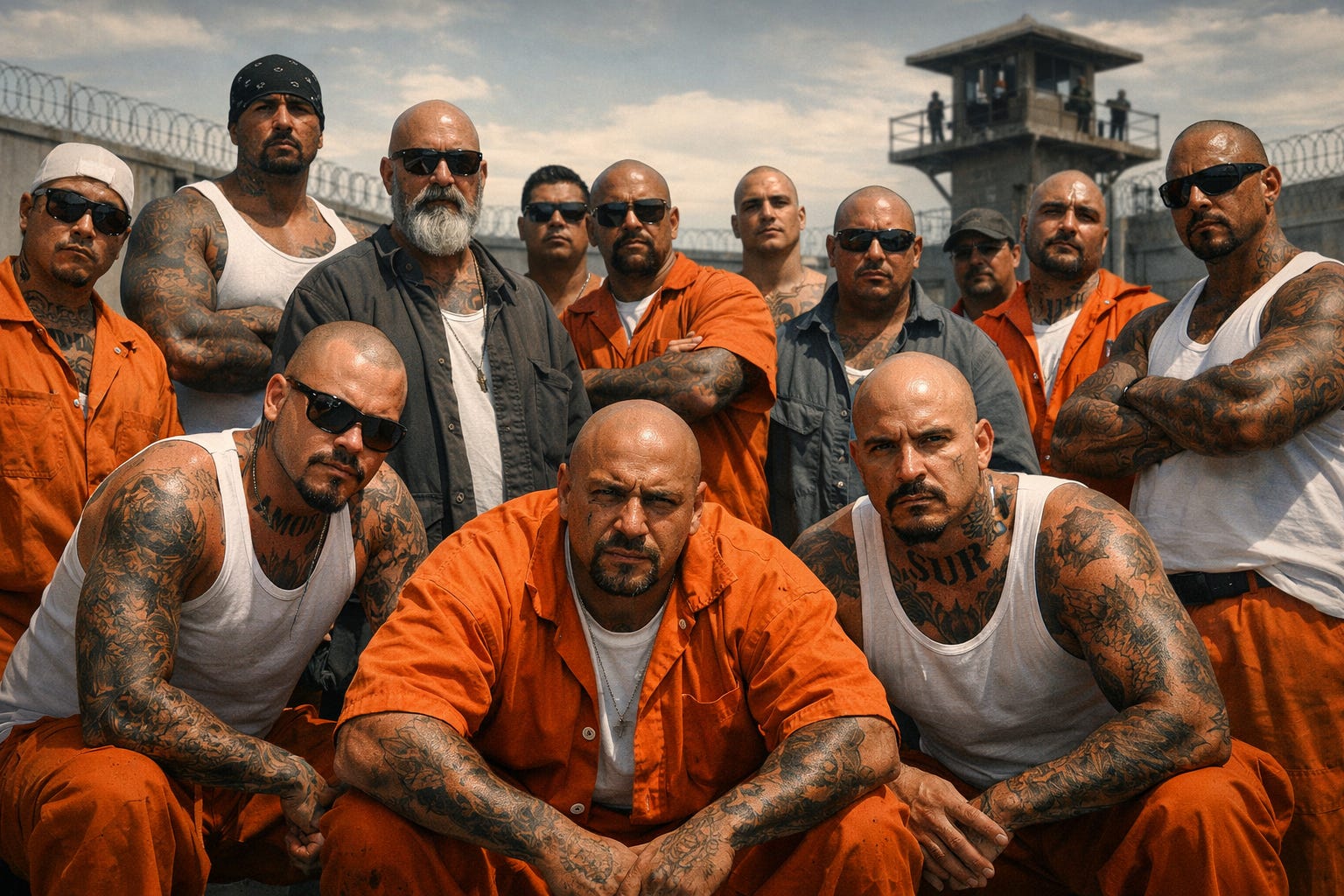
Still, might there be some promise here? What if instead of trying to suppress gangs and the natural desire of inmates to create safety and order themselves, prisons encouraged inmates to be their own wardens? This idea is less radical than it might sound, and has been done “successfully” many times all around the world. These systems are almost always much less expensive to the jailers, allowing shockingly high ratios of prisoners to guards, but they also typically come with high levels of abuse.
Some of the more prominent examples include:
The Funktionshäftlinge system in Nazi Germany's concentration camps.
There, kapos — Nazi collaborators — would supervise and discipline other prisoners in exchange for special privileges. In many cases these functionaries felt guilt and used their meager powers to protect their friends. In other cases they tortured and killed their fellow inmates. Regardless, “kapo” remains one of the harshest insults in some Jewish communities to this day.
The convict officers of the British Empire, particularly in the penal colonies of Australia, Singapore, and the Andaman Islands.
Surrounded by the natural walls of the ocean (and inhospitable desert), prisoners were allowed more freedom to move about, and were tasked with farming, construction, and other labor.7 To keep the huge prison populace in line, obedient prisoners could earn “marks” that allowed them to rise in a quasi-military hierarchy of policing and discipline.8
The trusty system9 of the American South.10
Only fully abolished in the 1980s, the trusty system was a way to profit from the cheap labor after convict leasing — itself an attempt to regain cheap labor after the abolition of slavery — became politically unpopular. At the top of the hierarchy were “trusty shooters,” armed with rifles and often selected for being murderers or otherwise violent enough to intimidate those working under their muzzle. While those convicted of murder often faced life in prison, for a trusty shooter, killing another prisoner could mean a cash bonus or even being rewarded with freedom. Those who were given power frequently abused it, sometimes torturing or raping the less privileged inmates.
While these examples are undeniably dark, I think it's worth recognizing that the abuse in these contexts stems more fundamentally from the way that these societies had little interest in the dignity or welfare of the prisoners. Indeed, places with different systems but with a similar level of apathy tend to also be hellholes, whether due to gang activities or mistreatment by guards.
And there are also positive examples of prisoners taking part in the hierarchy of the prison administration. In the early-mid-1800s, a man named Georg Michael Obermaier became a prison governor in Bavaria. Where the previous prison system was harsh and controlling, he removed chains and dismissed nearly all of the guards, appointing prisoners to be in charge of productive workshops and to serve as monitors to ensure good-conduct. Prisoners were treated with dignity and respect, and given progressively more freedom as they demonstrated trustworthiness, leading to lower levels of violence and bad behavior, as well as recidivism rates comparable to modern Norway. While some of Obermaier’s success was likely thanks to his charisma, his reformations were undeniably good at simultaneously helping prisoners and cutting costs, and promoted the concepts of parole and normalization.
Even more noteworthy is the Association for the Protection and Assistance of the Convicted (APAC) in Brazil. Founded in 1972, APAC now manages about 70 prisons with an average of about 100 prisoners each. And between all of them, there are zero guards on payroll. The prisoners, some serving life sentences for heinous crimes, are not only in charge of maintaining good conduct, but are also given the keys to their own front gate and trusted to not escape. Thanks to this, the labor of the prisoners, and some volunteer work, prisoners under APAC only cost about $2300 per year — less than half of Brazil’s national average of ~$5000 pppy.
This system largely works thanks to carefully selecting among many applicants, eager to escape Brazil’s awful prisons, and the recognition that escaping is most likely a path back towards serving more time in a nastier place. But it is also thanks to a self-perpetuating culture of dignity. When a prisoner first comes to an APAC prison, they are not immediately trusted, and are instead assigned to a strict schedule involving a lot of work. It is through this work that the prisoners get to know the new member, and learn whether he or she can be trusted with more responsibility and autonomy, such as dangerous tools, time unsupervised, or ability to leave on authorized trips. Those who show that they understand and have internalized the culture of dignity are allowed more freedom, and eventually go on to mentor and supervise newer inmates and have access to the keys.
Despite some claims to the contrary, these prisons have a significant number of escapes. In this master’s dissertation that investigates one facility’s record over 20 years, we can see 84 true escapes and 312 cases where prisoners who were released on temporary trips failed to return. If we focus entirely on escapes, which came from the ~90 inmates (at any given time) who had not yet demonstrated trustworthiness, that’s an annual escape rate of nearly 5% — close to a hundred times the US average. If we include the ~95 more trusted inmates that fail to return as escapes,11 the rate jumps to over 10%. Still, the vast majority of the prisoners choose to stay, which is a noteworthy accomplishment given the total absence of guards. Part of what keeps inmates from bailing is the fact that escapes result in loss of privileges for everyone on duty, meaning there is a sense of personal betrayal whenever someone leaves.
APAC’s recidivism numbers are better, though like the breathless reporting for Bastøy, there is a tendency for the media to be vague and reference bullshit statistics without citation. As best I can tell, about 14% of men and 2% of women who serve their time in an APAC facility end up being re-convicted after 5 years. The baseline for Brazil as a whole is closer to 40%, though estimates vary. Critics may argue that this is purely the result of cherry-picking the best-behaved criminals, but the escape statistics do not paint a picture of perfect selection. It’s clearly more than Bastøy can muster, either in terms of relative improvement or absolute recidivism.
Utopian Prisons
As explored in my second essay on Adjudication, I believe Utopia rejects the death penalty, torture, and slavery without exception, but sees “imprisonment” as a suitable punishment for criminals on the grounds that it is an extension of a land-owner’s right to prevent trespass. Just as anyone can kick a visitor out of their house, and local governments can exile people from a country, the world government can effectively “exile” criminals from “the entire world.”12
These people, whom I will here call “exiles,” are only allowed to live in spaces that have explicitly opted into accepting them. I’ll call these spaces that accept exiles “graceholds.”
Anyone, including an exile, can run a gracehold, as long as it meets a few minimum standards imposed by the government:
Walls — All graceholds must have a strong border that prevents exiles from leaving without an escort. An open futures market for the gracehold must anticipate less than a 1/36 annual chance of any escapes, and graceholds are held legally liable whenever escapes occur.
Library — All graceholds must have a library holding the Utopian canonical texts on-site, staffed by a librarian (who may themselves be an exile). Exiles living in the gracehold always have the same library access rights as anyone, including the right to private reading time.
Police — All graceholds with at least two people living there must have some form of police presence to enforce the universal law. This typically involves some of the exiles in the gracehold being employed as sentries — trained to watch for and report crimes. Gracehold police have the same anti-abuse mechanisms (e.g. body cameras and third-party reviews) that the normal police have.
Mail — All graceholds must permit exiles to send and receive private letters (not packages) as part of the standard global mail system, both on physical paper and electronic mail.
Graceholds do not need to have a policy of universal acceptance (though some do). If a particular exile is violating the rules of a gracehold, the owner is free to cast them out. Some graceholds are more like private clubs or estates, set up by wealthy criminals so they can live out their time in exile in luxury. There are Utopians who complain about the injustice of this, but the consensus is that it’s better to maintain the ethical high-ground than it is to give in to the desire for retribution.
Utopia takes the principle of normalization to the extreme. While some resemble our world’s prisons, most graceholds are closer to relatively normal communities. Most exiles live in private rooms or houses, own property, buy things at normal market prices (both locally and online), do relatively normal work, and live alongside members of the opposite sex (both other exiles and non-exiles).
Smaller graceholds tend to be good for criminals who need to build community relationships, sometimes forming bonds of friendship that last a lifetime. Larger graceholds can be more like microstates, holding thousands of people, most of whom aren’t exiles. These towns allow convicts who have demonstrated reform to live relatively normal lives.13
All of this can happen in a healthy way thanks to consent. Graceholds have the ability to pick and choose which exiles they accept, including by being able to evict them at a moment’s notice. On top of this, graceholds are incentivized to share information with each other about convicts, meaning that a single black mark at one gracehold can mean a world with vastly fewer options. This incentive landscape helps foster good behavior among the exiles.
And on the flip-side, it is technically a misnomer to say that exiles are prisoners because they always retain their universal right to emigrate. If a gracehold is being abusive (or even just being uncool), an exile can decide to move elsewhere. Moving is expensive, both in money14 and in the need to form new relationships, but because all exiles retain their universal right to a basic income, and graceholds can charge rent, there is usually a market for well-behaved exiles, somewhere in the world, at least.
While exiles that have economically valuable skills can sometimes afford to live near their homeland, it is typical for exiles to be forced to travel to a distant place as part of their punishment. The core function of a gracehold is not dependent on any location, so they’re often located on remote islands or in particularly inhospitable areas, to avoid having to pay the cost of building and securing walls.
Because graceholds are funded by basic income and the wealth/income of the residents, Utopian “prisoners” don't impose any additional cost on taxpayers. In fact, because exiles are frequently able to do productive work, graceholds are an important part of the world economy, adding to the wealth of all. These factors mean Utopian courts also experience less pressure for short sentences, and will frequently exile repeat-offenders for multiple decades, even for minor crimes.
In the extreme case where someone is so repeatedly awful that they become rejected by all the normal graceholds, the world government reserves land on a couple dozen tiny, uninhabited, rocky islands to serve as a last resort. Living alone in meager cabins, these worst-of-the-worst criminals are only really able to interact with the occasional mail-boat (often with police defenders) that comes to ensure they have enough food and books.
But people rarely end up in a gracehold of last resort. More commonly, if someone is consistently violent and unpredictable, they will be low-functioning enough that Utopia sees them as someone with mental illness. Justice is blind, and those with mental conditions can still be exiled, if they commit crimes, but they typically wind up in special hospital-like graceholds where their guardians can effectively manage their health and well being.
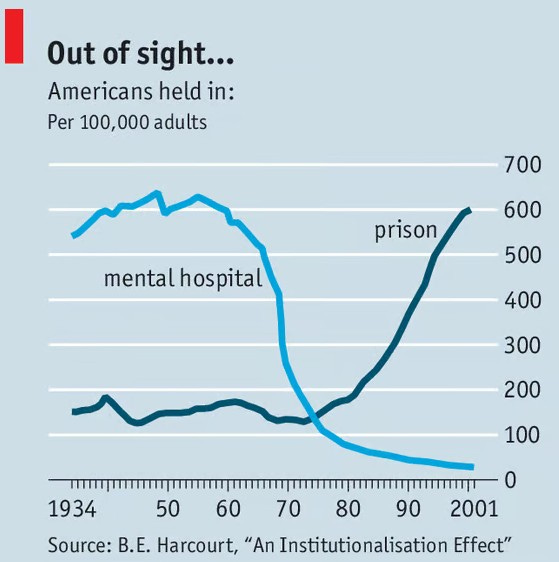
To be clear, there are better prisons and worse prisons even within single US states. I am not trying to say all prisoners experience all indignities — only that all prisoners (outside the rare exceptions) experience at least one of these pains every day.
While being assaulted in prison is horribly common, being murdered in prison is surprisingly rare, especially compared to how things are depicted on TV. Based on this report, there are ~10 homicides in prison per 100k prisoners in the USA. That’s about half that of Chicago, 2.5x that of NYC, and about the same as LA.
Suicide is often listed, at about 30% of all deaths, as the leading cause of death in jails, where people who expect to wind up in prison suddenly find themselves confronted with the harsh reality of what a life in confinement is like. In long-term prisons (partly due to survivorship bias), suicide is less common than things like cancer and heart disease, but it’s still the leading cause of death in young prisoners and the leading cause of unnatural death, at about 5% of all deaths (it varies if you look at state prison vs federal prison). This is despite it being much harder to kill oneself in confinement, of course.
Out in the wider USA, less than 2% of deaths are suicides. Does that mean the suicide rate in jail is 15x as high? Unfortunately, that’s potentially misleading, as the overall death rate in jail is also about five times lower, because sick/old people rarely go to jail. In terms of the deaths per 100k people it’s more like 14 vs 49 — only about 3.5 times higher.
Some people, such as Wesley Hohfeld, might argue that this conception of rights is too narrow, and that not all uses of the word “right” correspond to what might be classified as a claim-right, with a corresponding duty. I think that Hohfield’s distinctions are bad, and that rights framed in one way can be naturally re-framed in other ways without loss of content. Yes, there are more or less natural ways to communicate rights in English, but that is beside the point of what they are. All mandates can be trivially re-worded as prohibitions, et cetera. Here are four examples of various kinds of Hohfeld rights, and my sense of how they naturally fit into my definition, by marking {the duty holder}, then {the mandate}, then {the class of people who hold the right}:
“Right to be paid upon completing work” — Claim Right
{The client} must {pay money to X} for each person X {who has completed the job}.
“Right to walk in a public park” — Liberty
{Everyone} must {allow X to enter the park} for each person X {}.
“Right to make a will” — Power
{The state} must {allocate X’s property according to X’s written will} for each person X {who has made a will and then died.}
“Right to remain silent” — Immunity
{The court} must {allow X to not testify} for each person X {who is on trial}.
Something being “a social construct” doesn’t mean it’s entirely arbitrary or unnatural. Indeed, I would say that rights are basically always shaped to engage with certain aspects of nature, such as the necessary components of agency and the basic needs and other psychology of human beings. That said, I do think the “rights are natural” crowd is usually more wrong than the other camp. Consider, for example, that the rights of life, liberty, and property the pursuit of happiness, are neither “self-evident” nor “inalienable.” The Declaration of Independence was specifically written because the crown was taking these things away from the people and some people thought that was fine!
If you think that rights are very natural and obvious, why is there almost no consensus? Why did it take so long to identify “rights” as a thing at all? Why did it take centuries after that to deny slavery, and then put women on equal footing? Again, I don’t want to deny that all rights are somewhat natural, and I agree that the best rights tend to be more natural than the others, but it’s easy to get swept up in hallucinating that your particular conception of society is obviously correct. (Only *my* conception of society/Utopia is obviously correct. 😜)
Obviously it’s important to reward virtue, rather than virtue signaling. Attempts to signal virtue where none is present are reprehensible, and should be punished harshly. And one should be careful not to encourage people to waste effort on signaling, instead of spending that effort on doing good, especially if people get into competitive games with each other, filling up the attention space with ever-louder cries of how great they are. But at the end of the day, if someone has done good, and are showing that off, the correct response is almost always a sincerely felt “nice job!” instead of the derisive “oooh someone is virtue signaling!”
In the mid-1800s, as the dense jungles of Singapore were being cut down to build roads and pepper plantations, the colony suffered hundreds of deaths from man-eating tigers. To deal with the threat, prisoners from India with hunting experience were armed with muskets and tasked with sweeping the jungle on foot. While extremely dangerous, successful hunts could earn these volunteers massive bounties, some freedom, and even a kind of celebrity status.
One of the most reviled positions was “scourger.” These men were tasked with brutally flogging disobedient inmates (and could themselves be whipped for showing leniency). Despite being allowed money and extra privileges, scourgers were so hated in these colonies that they often took to drunkenness and were given separate quarters for the sake of safety.
Often mistakenly called the “trustee system.”
I'm lumping in the Building Tender (BT) system as a variation of the trusty system.
It’s not clear to me whether this is warranted. The 312 “abandonos” may include cases where men fail to check in at the appointed curfew, but still eventually return. I don’t know.
“Kick people out” is something of an oversimplification. People still have the right to find transportation to their next destination, for example, otherwise it would be possible to legally trap someone by owning all the land around them. Utopian property holders are required to allow travelers to move across their land if the traveler’s destination is most naturally reached by traveling through that land, including that there is no straightforward way to travel to their destination through public spaces. When crossing private land in this way, travelers are generally required to do so in a way that does not disrupt the land-holder. Those using the freedom-of-movement rights to harass or otherwise commit crimes are harshly punished.
Utopia doesn’t have a normal notion of parole. All convicts either serve time or pay a fine to avoid being exiled. When someone is deemed too dangerous to be allowed to simply pay a fine, it is rare for the government to change their mind. Instead, they typically must convince minimum-security graceholds to accept them, and demonstrate good behavior for in those highly-normal settings for years before they are allowed to pay off the rest of their time and rejoin society.
When an exile decides to move, they must pay their own way. But when a gracehold kicks an exile out, they are forced to pay for transportation to the nearest gracehold that has agreed to take that exile. Loans are ensured by the government to cover transportation costs for an exile’s first three moves, reducing the risk of someone getting trapped by not having funds to pay for an escape.
Rights are the minimum level of reciprocity necessary to enable productive collaboration ( civilization ).