
Symmetry Breaking
TLDR: The standard story is that the weak force breaks parity, but there are better models of fundamental physics that preserve symmetry and bring other perks.
Prerequisites: Having read Spacetime Distances will probably help, but isn’t necessary. I go into a lot of physics, especially in the later footnotes, and that might be more than many readers can comfortably handle, but I’m trying hard to make it as accessible to a general audience without glossing over the important bits.
Learning is the process of colliding with reality so that a model of the world forms in the mind. This world-model, which is essentially all you have conscious awareness of, is about the world, but it’s important to notice that it is not actually the world. The map is not the territory in many different ways.
Maps contain errors and omissions. The map can have a forest where the territory has a lake. When a map corresponds closely to reality, it is more “true.”
Maps fold up and fit in backpacks. This makes them convenient to work with, but also creates distortions that aren’t exactly errors, but can definitely still bias things if you don’t account for them.
Maps are naturally covered in labels, lines, and other notes. These notes are usually about real things, but they aren’t, themselves, literally in the territory.
In physics, the core principle of relativity is so simple and obvious that we often take it for granted: to compare maps, we must ignore the notes and try to line up the parts that are objectively true. The actions that we take to get the maps to line up should lead to both models having the same measurements — sym metries.1
A symmetry is a way we can change the superficial characteristics of our models without making them any less true. The relative distances between cities are objective facts, but the choice to put north at the top of the map is arbitrary. We are free to translate and rotate “the whole world” (which really just means moving our perspective) without any real effect.
But symmetries imply something even more powerful than the ability to see the whole world from a new angle. If two map-makers make different choices about how to represent the world, it indicates that there is a dimension along which parts of the world (that are otherwise very similar) can differ. The ability to move the lines of our Cartesian grid is a hint that the position of individual objects is variable — if you see an apple in one location, you can see an apple in another location. The ability to rotate our coordinates implies that objects exist at a variety of angles and orientations. The fact that we can flip all the coordinates and preserve the relative distances between things means that if we see a left-handed glove, we should expect a right-handed glove to also be possible.
Right?

Clockworld
Let’s set aside our universe for a bit and consider a two-dimensional world inhabited by various fundamental objects, like triangles and spirals and so on. Just as in our world, we can imagine translating, rotating, and reflecting the space, without really changing the way these objects interact. As long as the positions, velocities, and angles are the same relative to each other, things will play out in the same way.
Let’s now introduce an arrow-shaped object that we’ll call a “clock” because of a special property: if a clock object spins anticlockwise, it will quickly delete itself. Thus a box full of clocks that are spinning in all sorts of ways will quickly become a box full of clocks that happen to be spinning clockwise, because any that are spinning the other way will disappear.
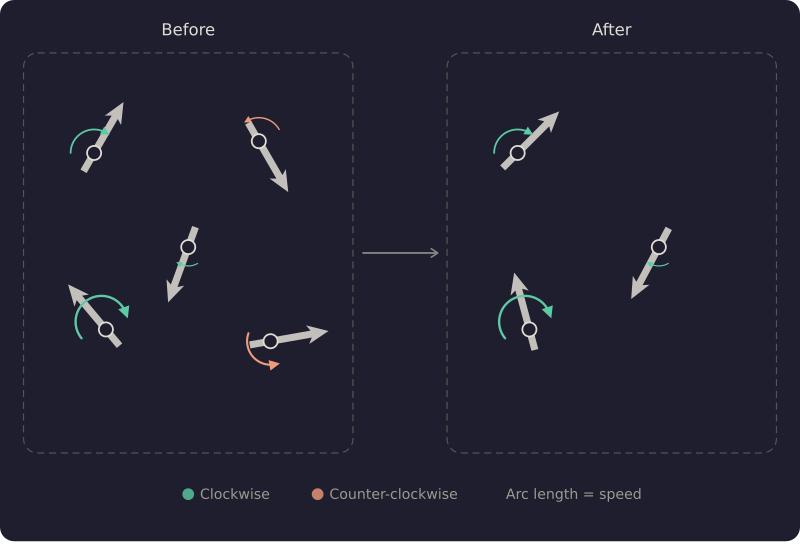
In physics lingo we say that the self-deleting rule for clocks “breaks parity.”2 Because the orientation of the clock matters for what actually happens, it means that we can no longer reflect the universe and consider that perspective to be equally valid under the same laws of physics.
When parity seems to be broken, there are a couple options available to us. One is to shrug and conclude that “reality picks a side” — that there’s something fundamentally real about the orientation of things, beyond their relationship to each other. Another option is to guess that the supposed “violation” of symmetry is actually a clue that you missed something. For example, what if the supposedly “fundamental” clocks are actually a combination of two parts: a big, obvious clock-hand, and a tiny, internal clock hand that is also turning clockwise?
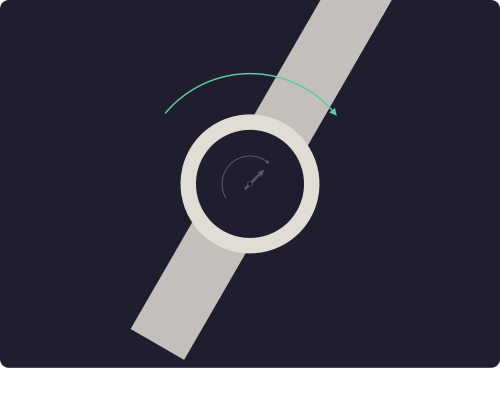
This change lets us frame the clock rule as about the relative properties of the parts: “If the big hand is turning opposite the small hand, the clock destroys itself.” Or, if we don’t want to think of the internal hand as a separate object for some reason, we could alternately say that the clock has a “clockwise flavor” and the rule is “If the clock spins opposite its flavor, it breaks.” Regardless, the key here is that when we reflect, we must also flip each clock’s “clockwise only” rule to become “anticlockwise only” to ensure the mirror universe has the same outcomes.
Attaching the rule to the clocks themselves, rather than the universe as a whole, is aesthetically satisfying in addition to keeping the physics consistent. The universe seems to respect the obvious symmetry in all other cases, so it’s much cleaner to find a story for the behavior of the edge case that is genuinely about the edge case, rather than letting it shatter the core principle.
But symmetry isn’t only about global changes. If it’s possible to flip the orientation of all the clocks — whether via internal hand or flavor or whatever — couldn’t we flip only some clocks? The restoration of symmetry predicts there should be anti-clocks hanging around in the same world that the clocks inhabit.
The story of clockworld is fictional, so we can freely decide that anti-clocks do or do not exist alongside normal clocks. But it turns out that there’s a remarkably similar phenomenon in the real world, and it probably isn’t the one you’re expecting…
A Quick Note On Handedness
In our universe, almost everything has “angular momentum” — a quantity of spinning, analogous to the way objects can spin in the 2D universe (but, unfortunately, with a bunch more complexity that’s mostly irrelevant to our current topic). For example, each atom in a hunk of metal is composed of a cloud of electrons surrounding a tiny, central nucleus. The nucleus, in turn, is made of a dense swarm of protons and neutrons, which are themselves made of a cloud of quarks.3 Each of these objects — whether it’s an atom, electron, nucleus, proton, neutron, or quark — has an angular momentum.
By convention, we use “the right-hand rule” to relate rotation to (linear) direction.4 If you curl up the fingers on your right hand in the (angular) direction of rotation, we say the object’s angular momentum is pointing in the direction that your thumb goes if you stick it out like a hitchhiker.
Notice that if we could actually see a ghostly right-hand around some spinning object, and that hand always followed the right-hand rule as a law of nature, this law would violate parity. If we place a mirror in front of the object (parallel to the plane of its rotation), the version in the mirror will still, from our perspective, be spinning the same way. Thus the ghostly hand won’t flip. But the ghostly hand, by the rules of basic reflection must have flipped. Contradiction!

The right-hand rule is just a convention, however, so as long as we only use it to relate the rotational dynamics of different things in the same universe, we’re fine. For example, a rotating charged object (or a spinning electric current, like in a solenoid) will produce a magnetic field5 in the surrounding space. This magnetic field is naturally about spinning, so we can use the right hand rule to pick out which way is “north.” If we place a hunk of metal in the field, the (electrically charged) quarks in the metal will be pressured to move in ways that makes the angular momentum of their nuclei either match the direction or point in the opposite direction of the field. But despite the language of “direction” this is just spinning affecting spinning, akin to an assemblage of gears.
The Wu Experiment
At the temperatures we normally encounter, the kinetic energy of the particles in a hunk of metal will usually mean their rotational directions will be super random, even if there’s pressure from a magnetic field. But if the metal is sufficiently cold and the magnetic field is strong enough, more and more of the particles in a chunk of metal can be made to consistently spin in a desired direction.
Because the protons and neutrons in a nucleus are bound tightly together, it usually makes sense to consider each nucleus as a whole. And if the metal nuclei happen to have a positive gyromagnetic ratio,6 they will spin clockwise from the perspective of someone looking from the south end of the magnetic field towards the north end. In the language of the right-hand rule, we say they’re pointing north.
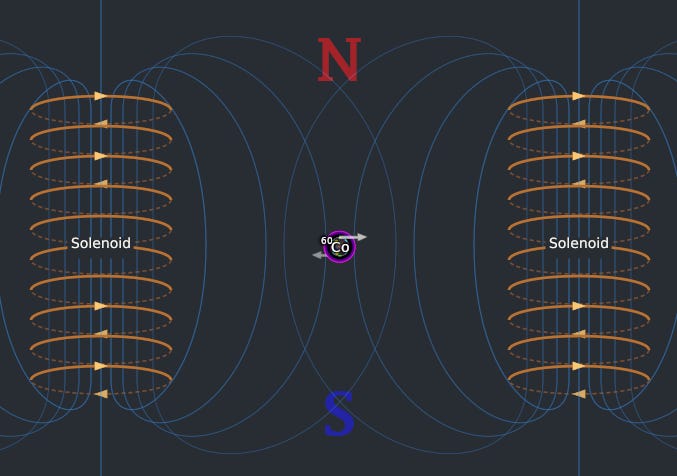
Again, the right-hand rule is a human convention. Everything shown in that picture is actually reflectively symmetric, including the magnetic field.
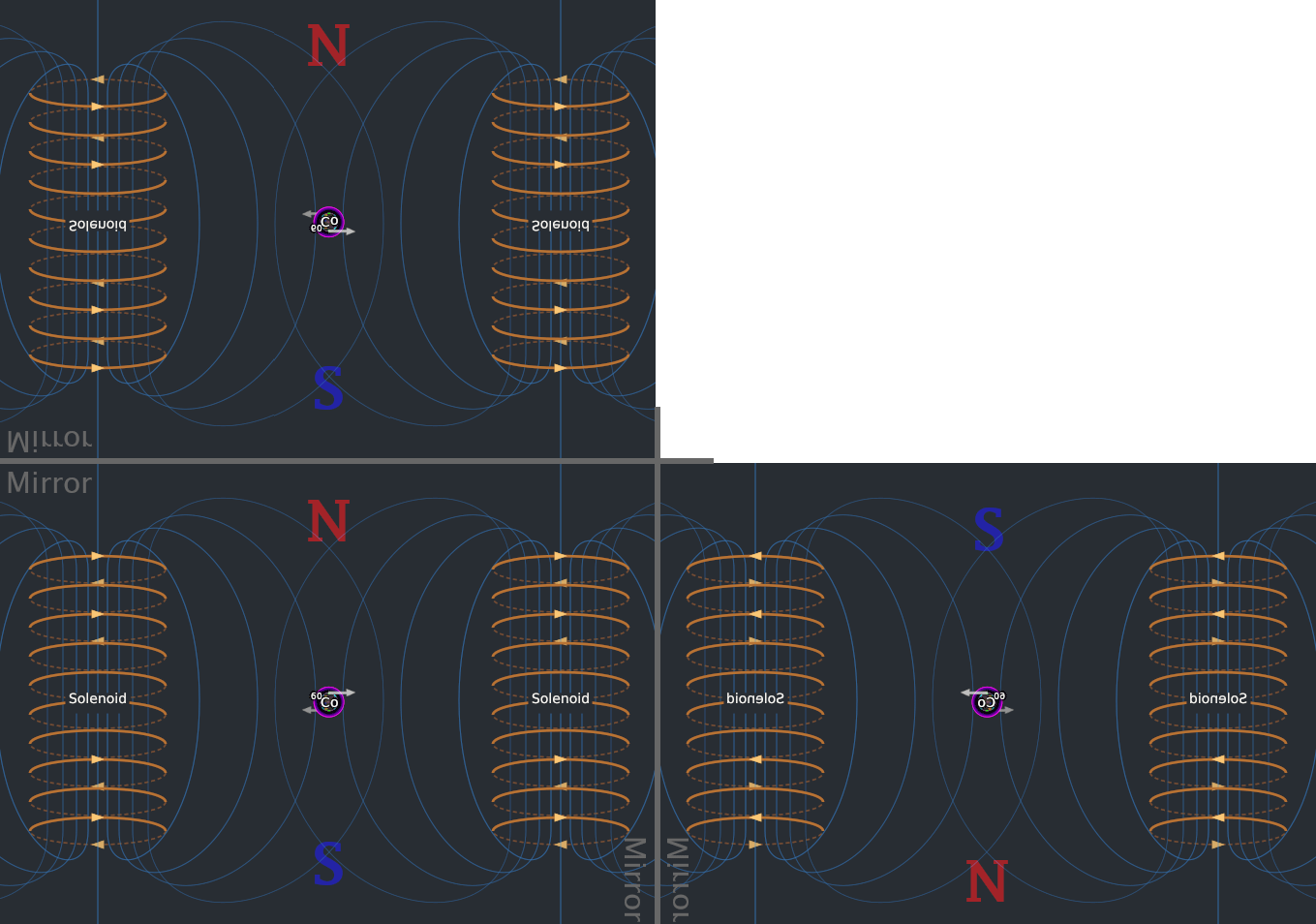
If the metal in question is also radioactive (eg Cobalt-60), neutrons can spontaneously decay into protons by having one of their “down” quarks change into an “up” quark, spitting out an electron and a neutrino in the process.7 To contrast with the strong force that holds the nucleus together, the mechanism that produces this radioactive decay is considered part of “the weak force.”
If you'd asked any physicist in the middle of the 20th century whether the electrons radiating from the metal would be biased towards the north vs south end of the experimental setup, they would have rejected the notion. How could there be? Everything involved is symmetric!
Chien-Shiung Wu, in 1956, was the first person to actually check. And as it turns out, nearly all of the electrons go south. The standard explanation is that even though all the objects are symmetric, the weak force itself is not. The right-hand rule (or rather, the left-hand, since the electrons go south) was declared to be a real law of nature that violates parity.
Nobel laureate Wolfgang Pauli (who almost bet a large amount of money on the outcome) was one of the many scientists to be not only surprised, but deeply unsettled. Just before the experiment, he wrote: “I cannot believe that God is a weak left-hander.” And later: “Now after the first shock is over, I begin to collect myself. Yes, it was very dramatic.”
After a failed attempt to rescue parity by trying to unite it with the matter/antimatter split, much of the physics community shrugged and declared parity to be dead.8 But this is not the only option. If we want to rescue symmetry, we must turn to an even more bizarre story. Thankfully, most of the weirdness is already included in the standard model, and well validated by experiment.
The Fabric of the Universe
As I discussed in my essay on smoothness, we should be skeptical, on principle, of any story of matter that treats it as made of discrete particles. Indeed, a more real picture is that what we usually think of as “stuff” is more akin to ripples moving along a piece of fabric. Just as light can be seen as waves in the electromagnetic field, electrons and quarks can be seen as waves in their respective “Dirac fields.” In this picture of reality, “empty space” — vacuum — is merely a part of reality that doesn’t have ripples. But, importantly, it still has fabric.
Not all possible vacua are identical. One of the most celebrated predictions in the history of physics was the 2012 observation of the Higgs boson — the particle (ie quantized excitation) of the Higgs field, first proposed in 1964. Though Higgs bosons are extremely rare, the character of the Higgs field itself constantly influences the other fields — the vacuum itself can be seen as having an omnipresent structure. And importantly, this structure has a kind of directionality built into it, as though the weave of the fabric has an orientation.
In the very early stages of the universe, the Higgs field is theorized to have been more symmetrical — lacking this intrinsic orientation, but having a higher intrinsic energy. But as the universe cooled and expanded, the vacua in various parts of reality settled into more stable configurations in a process called “spontaneous symmetry breaking.”
We can see a similar phenomenon at a more human scale when hot metal cools into crystals. In its heated state, the orientation of atoms in the metal is chaotic and without any directional bias. Then, as the metal cools, atoms nest together in a lattice of repeating patterns. When crystals in different parts of the metal have different orientations, a boundary forms between them, where the orientation suddenly shifts. (Blacksmiths repeatedly heat and cool metals to manage these boundaries, as they can lead to brittleness.)
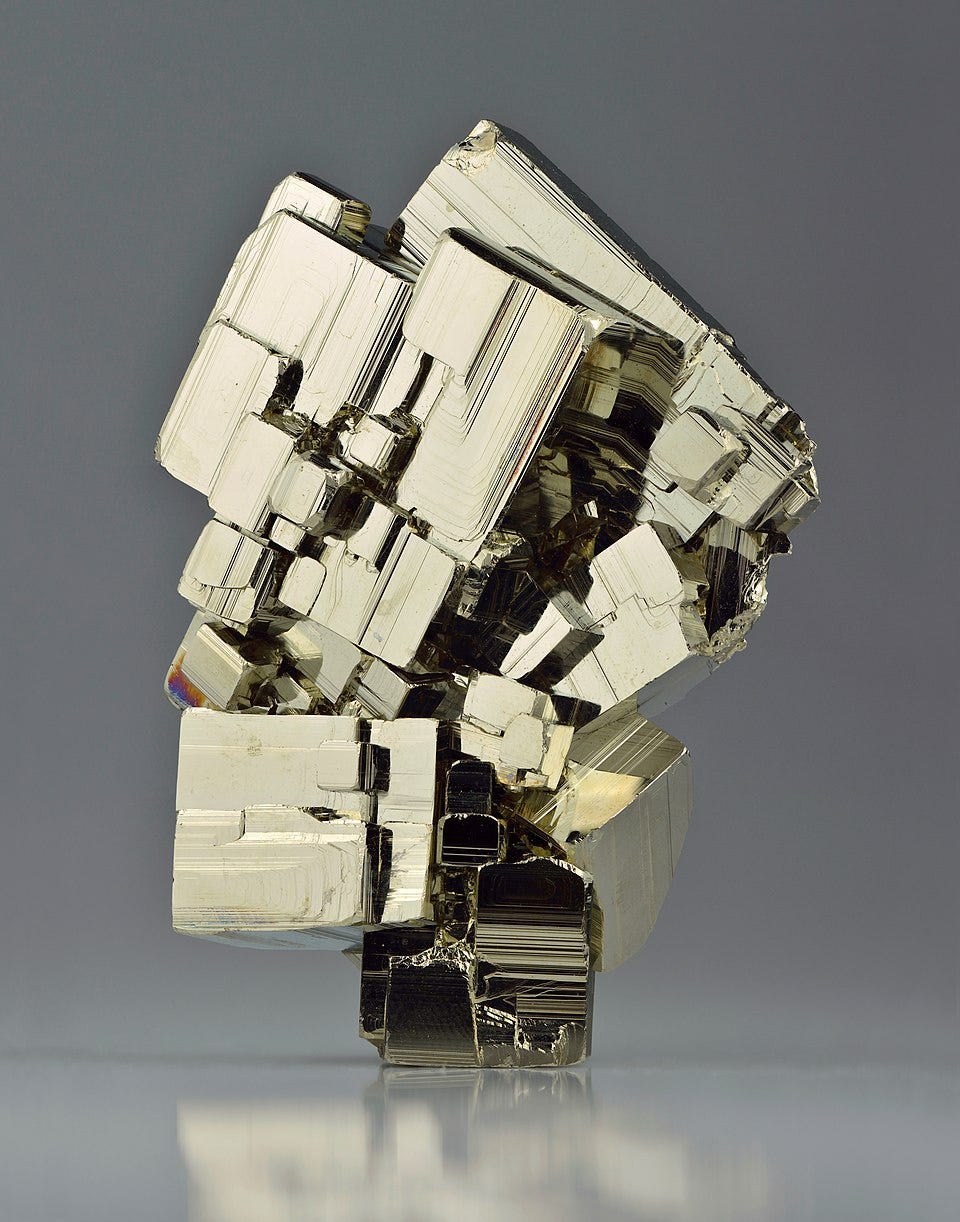

While the asymmetry in the Higgs field is more complex than a simple direction in space, and usually isn’t used to explain the asymmetry of the weak force… might there, nonetheless, be a way in which our particular vacuum secretly forces a handedness to things? If so, we could easily explain the supposed parity violation of the Wu experiment as an oversight — we forgot to flip the vacuum!
Left-Right Symmetric Models
In the standard model of physics, the electron field can be viewed as two distinct (sub)fields, which we label as either having a left or right “chirality.” This use of “left” and “right” comes from the way these components relate to the right-hand rule for angular momentum. As usual, reality is more complex than a summary can capture, but at a very high level, right-chiral particles want to travel in the (right-hand rule) direction of their spin, and left-chiral particles want to go the opposite way. I'll relegate a more complete explanation to the footnotes.9
Regardless, it’s important to remember that chirality is about the existence of multiple types of things, rather than about how things are turning, per se. To reduce the chance of confusing right-handed spin particles with right-handed chirality, I’ll use the individual letters “L” and “R” to refer to chirality — the two kinds of matter.
Wu’s experiment demonstrated that nuclear decay produces electrons which tend to move opposite the direction of their spin. Does this mean they’re L chiral? In truth, all electrons are a mixture (“quantum superposition”) of L and R states, with energy simultaneously flowing back and forth between their two chiral fields via the Higgs field. (It’s this flowing energy that gives electrons their mass.) But particles, particularly high-speed particles like the emitted electrons in Wu’s experiment, can still be disproportionately one chirality or the other.
In the standard story, quarks, too, have L and R components. But neutrinos — the only other form of matter,10 and importantly, one that basically only interacts via the weak force — don’t. We’ve never seen a neutrino with any notable R component. In theory that means neutrinos should be massless, but we know that’s not the case from other experiments. It’s an open question both where their masses come from, and why they’re so light — the mass of the neutrino is over a million times lighter than the electron.
When we observe the weak force, we only see it coupling to the L side of matter, and in the standard model this asymmetry is baked in as an assumption. It’s also broadly agreed that the Higgs field symmetry broke in a particular way, and that this gave rise to our particular vacuum, which in turn determines how much energy it takes to create a particle that carries the weak-force (“W and Z bosons”). But suppose that these two facts are connected, and there’s a parallel version of the weak force that would operate on R matter, except the vacuum demands extremely high amounts of energy in order to push energy through it — the weave of the universal fabric is so stiff as to effectively eliminate the possibility of a ripple.
In a left-right symmetric model, this is exactly what is supposed. Nature set up initial conditions that were nice and symmetric, and then something broke that symmetry such that the L and R versions of the weak force came apart. Very nicely, because the asymmetry comes from the Higgs field,11 and the Higgs mediates L-R interaction to give things mass, the R neutrinos that we are forced to add to our picture of reality in order to keep things symmetric are both too massive to show up (in our vacuum) and simultaneously make L neutrinos extremely light but still give them some mass.12 This trick is called “the seesaw mechanism” and is so elegant that adding heavy R neutrinos is a common move when extending the standard model. Having a broader LR symmetry simply means you get them from underlying principles.
LR symmetry also gives a few other nice things13 in the same sort of way, and is a very common feature in so-called “grand unified theories” of the cosmos (including string theories). The biggest reason14 it hasn’t been accepted as a canonical extension of the standard model is that we don’t have any direct evidence — it’s all theoretical speculation.
Utopian Symmetry Breaking Resilience
Utopia is not afraid of theory, even when it’s speculative. Instead, people in Utopia tend to be far more averse to being unprincipled, whether in their social structure, personal life, or scientific theory.
A big part of the way that ideas are judged in Utopia is according to their simplicity and elegance, and symmetries are a primary source of natural elegance. With each symmetry, we can ignore some of what’s on on our maps as irrelevant detail. A circle is more symmetric than a square, and it’s not a coincidence that a circle can be specified with less information — that symmetry is a direct reflection of its simplicity. On priors we should expect the deep structure of the universe to be highly symmetric.
This is why the notion of a parity violation should be upsetting. The world is so incredibly close to looking like we could put it in the mirror without breaking anything. Parity is necessary to allow for time to be reflected, and thus for allowing a bi-directional deterministic view of the universe. This foundation is so important, that Utopians are more than happy to adopt more speculative models, rather than abide the blight of arbitrary directionality.
And so, my guess is that the Utopian response to the Wu experiment is probably similar to their response to the double-slit experiment and other indicators of quantum weirdness. They certainly don’t ignore the evidence, but they also don’t let it totally shatter the traditional ontology.15 Instead, Utopians look for ways to accommodate the new data using elegant principles, and are more likely to adopt beliefs like the many worlds interpretation or some kind LR symmetry.
And ironically, in the end, hunting for elegant methods of preserving a simple worldview is an epistemic move that has a well-proven track record. From Copernicus to Darwin, scientific revolutions have often come from a place of trying to find clean and simple stories that explain the seeming complexity of the world. When symmetry and elegance are threatened by an unexpected result, Utopia rises to the challenge with a hunt for even deeper symmetries, and the better physical models that emerge in the process.

False etymology warning: “Same” (from Old Norse “sami”) has an entirely unrelated etymology to “symmetry,” which comes from the Greek roots “syn” (with) and “metron” (measure). The meaning here is so close that I still think it’s a reasonable mnemonic/pun.
Somewhat obnoxiously, the word “parity” is a little vague, even in the specific context of physics. Some sources say it is an inversion of a single spatial coordinate. Others say it is the inversion of every coordinate. When working with odd-dimensional worlds that allow rotation, these are pretty similar. The latter definition is nice in that it avoids ambiguity about which axis is being reflected. (Consider that the way something is rotating might or might not change in a reflection, depending on where the mirror is placed.)
But in 2D worlds, a reflection along both axes is just a 180° rotation and thus doesn’t engage with rules like “clockwise rotation only” that we usually think of as breaking parity, making the first definition more general. Physicists tend to use whatever meaning is most convenient, letting their math resolve the ambiguity. But since this essay isn’t terribly mathy, I’ll stick to the single-inversion definition and try to be careful to note how things get reflected, when relevant.
Nucleons are composed of gluons, as well as quarks. I went back and forth on whether to mention these nuclear bosons, since it seems misleading to include the atomic bosons and say that atoms are a cloud of electrons and photons surrounding the nucleus, or to describe the nucleus as made of gluons. Of course, the binding energies within a nucleon are close to 99% of the mass, which is very much not true for those other scales. I still decided to skip it and keep the gluons confined to this footnote. (Gluons love being confined, so I don’t feel that bad about it.)
We call the directions that result from applications of the right-hand rule “pseudovectors” to flag that they don’t flip the same way as normal vectors as part of a reflection. Indeed, when all dimensions are flipped, pseudovectors are unchanged, just as the underlying rotations are also unaffected.
Magnetic fields aren’t actually intrinsically about circular motion, but all magnetic forcefields are still pseudovectors, which are most naturally seen as “about rotation.” The full story of magnetism is incredibly complicated, and beyond the scope of this essay.
Gyromagnetic ratio is the quantity that relates the angular momentum of a body to the strength of magnetic field that it produces when it spins. In most cases the sign matches the electrical charge of the body. The proton, for instance, has a positive ratio. Unfortunately, this heuristic is not a hard and fast rule. Nitrogen-15, for example, has a positively charged nucleus with a negative gyromagnetic ratio. Neutrons happen to also have a negative value. While it’s theoretically possible to calculate gyromagnetic ratios from first-principles, in practice we just measure them.
This process is β− decay, mediated by a (virtual) W⁻ boson. Technically the “neutrino” is actually an (electron) antineutrino, though it’s an open question whether these are meaningfully distinct. If the neutrino is its own anti-particle (a “Majorana fermion”), then the “antineutrino” is simply the name for the opposite-chirality version of the neutrino. This turns out to be necessary for the seesaw mechanism described later in the essay.
(I use the term “opposite-chirality” here instead of “right-chirality” to make it clear that the neutrino still (almost exclusively) exists in the L field, rather than the R field (which would make it extremely massive). The fact that right-chiral particles (like antimatter) can exist in L-chiral fields is exactly the kind of obnoxious detail that makes learning/writing about this stuff so fraught.)
I find these attempts to “rescue” parity (P) by unifying it with charge (ie matter/antimatter), or with both charge and time symmetries, to be a little wrongheaded, at least with the benefit of hindsight. While the full story of charge extends well beyond the scope of this essay, there are good reasons to see it as intrinsically linked with time, such that reversing time naturally involves seeing matter as antimatter and vice versa. Given this, we should expect on priors that splitting up charge inversion (C) from time reversal (T), such as in a CP transformation, won’t work. And indeed it doesn’t.
But it does almost work. It seems to fix the Wu experiment, for example, and the violations of CP symmetry are genuinely quite subtle and exotic. What’s going on?
Well, consider that it’s a proven theorem that CPT symmetry works. Again, I claim that on priors, we should expect this. Our spacetime is 4 dimensional, and while full rotation isn’t straightforwardly allowed, it's fairly predictable that reflecting across every dimension in an even-dimensional universe (determinant 1!) should be valid. If we assume that this is true, then a CP transformation is almost a CPT transformation, and so we might’ve expected it to almost work.
But regardless, none of these moves actually rescue parity. The real symmetry to care about was simple reflection, and that’s where I think the theorists should’ve concentrated their efforts.
This footnote is, alas, also an oversimplification. To access deeper layers of the onion, one must have a strong handle on the nature of momentum and the quantum wave functional. I might eventually write about mass and momentum, but it’d take a full essay in itself. Anyway, caveat lector.
Electrons, despite not being made up of smaller parts, have a kind of intrinsic angular momentum called “spin.” Unlike the spinning of a composite object, the spin of an electron always has a fixed magnitude — they can’t “spin faster” or “stop spinning,” only the direction of the spin can change. (They can, however, mix spins in quantum superposition, which adds a layer of complexity here that I’m largely glossing over.)
If a chiral particle is massless, and thus there is no interplay between L and R subfields, then it will be either entirely R or entirely L. If it’s purely R, it will move parallel to the (right-hand rule conventional) direction of spin. If it’s purely L, it goes the other way. In this way, we conceive of pure chirality as essentially a description of which direction a particle is moving, relative to its intrinsic orientation. (If we imagine a particle that has no chiral flow, but somehow starts out in a more balanced state, its two halves will immediately shoot away in opposite directions at the speed of light.)
Particles like electrons do have mass, however. If we dump energy into the L subfield, it will immediately start flowing into the R field and back again in a continuous loop that makes pure chirality impossible. (As a consequence, if we want to cleanly talk about how the angular momentum of a particle lines up with its direction of motion, we’re forced to define a distinct property: “helicity,” which is, confusingly, also described using the language of “left” and “right” and is often conflated with chirality. I mention it mostly as a heads-up; I think helicity can be ignored for this particular footnote.)
For any (chiral) particle at rest, the balance between its chiralities must be exactly equal. If we then boost into a frame of reference where it’s going at relativistic speed, we will see the chirality as extremely lopsided, almost as though it were massless. In this way, the chiral balance of massive particles tracks the particle’s momentum. Indeed, arguably, the bias between L and R is what speed is. For a particle with a fixed and definite spin and direction of motion, there is a one-to-one relationship between the two quantities — they are interchangeable.
To understand why this might be the case, consider a fake, cartoonish version that involves pure particles taking discrete steps. First, in a perfectly balanced setup, we might say that the particle start as purely R and move forward some distance, then it flips to L and moves back to where it started, repeating endlessly. In a sense, this particle is always “moving at the speed of light,” but because of the balanced coupling, it ends up jittering back and forth and doesn’t go anywhere. A version of this idea, first proposed around 1930, is called “Zitterbewegung” (lit. “jittering motion”).
But of course, reality is smooth, so my Zitterbewegung story cannot literally be true. To highlight the unreality, consider that special relativity slows down the internal processes of things that approach the speed of light. If a particle was supposed to jitter back and forth at the speed of light, its clock would be frozen, and thus it would never find the time to flip itself to moving the opposite way.
But Zitterbewegung can still have an element of truth. The continuous flow between the chiral subfields is genuinely what slows things down and allows them to appear “at rest.” And if we stretch our imaginations a bit and see the L and R components as literally moving in opposite directions, we can see how it might be possible to have a particle that has a bias one way or another (as we see in Wu’s experiment). Naively, we should expect any disproportionately high level of L to flow into R and back again, resulting in an equal (albeit oscillating) balance. But let’s consider a particle that’s moving very quickly in the R direction (ie aligned with some definite spin). If we imagine that the R component of the particle is moving alongside the overall packet and the L component is moving opposite, then the R component is moving significantly closer to the speed of light, and thus switches to L more slowly. The component moving opposite the particle’s travel is at a lower overall speed, and so it flows quickly into the other chirality. The component moving with the travel is closer to the speed of light, and so it flows slowly. This imbalance in flow rates is what produces the asymmetry we see.
Again, this story should not be taken too seriously, as it obscures and leaves out several things, such as how particles that don’t have a definite spin or direction of motion behave, and how all this fits into a picture where fields are more fundamental than particles. I recommend researching “the Dirac equation in the Weyl basis” to get at a more rigorous picture.
In the end, there isn’t really a clean distinction between “matter” and “energy” — it’s all just fields underneath. Still, insofar as it makes sense to call some things “matter,” I think it makes sense to say those things are made of a type of particles called “fermions”: electrons, up quarks, down quarks, and neutrinos. There are also force-carrying “bosons” (eg photons), but the standard frame sees things like photons as a way that matter interacts, rather than a form of matter itself.
Most fermions (or perhaps all fermions, depending on how neutrinos shake out) can be characterized as having an orientation in time, which we label as “normal matter” or “antimatter.” (Note: This is the Feynman-Stueckelberg interpretation, and is not a consensus view. Still, it’s correct. 😛) Much like we see spin-up electrons and L-chiral-dominant electrons as not fundamentally distinct from spin-down and R-chiral-dominant electrons, I think it is correct to see anti-electrons as not fundamentally distinct.
The standard view is that there is a fundamental distinction that I haven’t mentioned, called “generation.” In this frame, the electron is a fundamental particle, and the muon is a different fundamental particle. I think this is probably wrong, similar to the way that it turns out that oxygen is not fundamentally distinct from nitrogen. Consider, as a starter, that neutrinos oscillate between generations. Given enough time, an “electron neutrino” naturally becomes a “muon neutrino” (neutrino generations are, somewhat confusingly, named after the various electron generations) — generation number is not conserved. There is a similar story for quarks, where the weak force allows a higher generation quark to change into a base quark by emitting/absorbing a W boson. In my mind, higher-generation particles are a kind of internally-energized version of their base forms. Though this is certainly speculative and an oversimplification (eg why is it nearly impossible to change an electron into a muon by pumping in gamma rays?), I think it captures the way that high-generation fermions are more like a variation on the base generation than a fundamental distinction.
The particle generations are still pretty mysterious and a topic of active research in particle physics. Time will tell whether my intuition is right just how wrong I am.
It’s mildly wrong to say “the Higgs field” as though the LR symmetric model has the same field. In the standard model the Higgs field provides a single “doublet” that breaks symmetry as described earlier. In a LR symmetric model the Higgs is usually assumed to have on the order of five times as much information (eg a bidoublet and two triplets), though the specifics vary depending on the exact model being proposed. Equivocating between these versions of the Higgs field hides that complexity.
The first step in understanding the seesaw mechanism (in LR symmetric models — multiple types of seesaws exist) is to reflect on the fact that neutrinos are neutral.
On the surface, this might seem boring. Most matter is effectively neutral. But neutrinos are fundamental particles, and this produces a unique dynamic that we don’t see in neutral composite objects, like neutrons. Specifically, without charge, the only distinction between neutrinos and antineutrinos is how their spin relates to their direction of motion. It’s theorized (though not consensus) that this means energy in the normal neutrino (sub)field can flow into the antineutrino (sub)field and vice-versa in a similar way to how the chiralities flow into each other. And just as mutual energy flow between chiralities creates mass, the flow between matter and antimatter, often described as “the field coupling to itself,” also gives rise to mass. Particles with this property are called “Majorana fermions” and the mass they get from this dynamic is “Majorana mass.”
In a LR symmetric model, neutrinos have Majorana mass and chiral mass. But, critically, the Majorana mass of the L field is allowed to be distinct from the R field. When the Higgs field broke symmetry, the vacuum settled in a way that set the binding strength between various fields (which we see in the various chiral masses). But suppose there was a term that pushed the vacuum to make the Majorana masses as different as possible. This would simultaneously explain why there are extremely light neutrinos associated with one chirality, and extremely heavy (and thus rare/quickly decaying) neutrinos associated with the opposite chirality.
Beyond restoring parity symmetry and naturally explaining (L) neutrino mass via the seesaw mechanism, there are two main selling points of LR symmetric models:
Derivation of (weak) hypercharge
The standard model demands a conserved quantity called “hypercharge” to generate the symmetry for the electroweak interaction. Each particle has its own hypercharge, but the specific numbers involved have a somewhat arbitrary character. In LR symmetric models, hypercharge can be easily and cleanly derived as the sum of two natural quantities (specifically (B-L)/2 and the R version of weak isospin).
While this is a win for elegance, I think hypercharge is less arbitrary than it’s often characterized. Once the other properties of particles have been specified, anomaly cancellation forces the hypercharges to be uniquely determined. The real win for LR symmetry here is in forcing the structure of R particles to be the mirror of L particles, which is visible in the more straightforward derivation of hypercharge.
Explaining why antimatter is rarer than matter
Very shortly after the big bang, after symmetry breaks but while things are still extremely energetic, LR symmetric models predict we’ll see a lot of (heavy) R neutrinos that quickly decay into (Higgs bosons and) charged particles (various flavors of electrons at first, which then go on to decay into quarks). If these neutrinos are their own anti-particles then they can freely decay into either matter or antimatter. In some LR symmetric models, subtle biases from the orientation of the vacuum can slightly favor matter over antimatter.
But as I understand it, this story doesn’t really depends on LR symmetry itself (or on the weak force), only on having heavy R neutrinos that have some bias in how they decay (usually by baking the bias for matter into the Yukawa couplings, rather than the vacuum state). Still, insofar as an LR symmetric model naturally involves symmetry breaking that creates heavy neutrinos and/or biases how they decay, that solves one of the more famous open problems in physics.
The other main problem with LR symmetry is that it predicts the existence of domain walls. Unlike the well-established symmetry breaking of the Higgs field, which is continuous and can change smoothly throughout the universe without producing notably different physics, the symmetry breaking proposed here is discrete. If different parts of the vacuum collapse in opposite ways, they create a boundary between them where space flips from one kind of physics to another across an extremely small distance. Domain walls like this would, as I understand it, be extremely energetic, and be visible as we look out across the cosmos — or perhaps even disrupt surrounding matter during the early stages of the universe in a way that prevents galaxies from forming. Needless to say, we have not seen any such phenomena.
That said, there is an easy explanation for the domain wall problem that doesn’t require adding any asymmetry back into the model: inflation. If the universe underwent a period of rapid exponential expansion after the left-right symmetry was broken — a commonly held theory for unrelated reasons — then any domain walls that had already formed would have been stretched so far apart that our observable universe almost certainly wouldn’t contain one.
The traditional physics ontology, prior to the discovery of quantum physics was of a highly mechanistic, fully-determined structure. This is in contrast to the traditional folk ontology, which I don’t think has any particular weight in Utopia. Things can be pretty different than they seem to the layperson!
The only difference between fabric and ripples is scale.